

Something Doesn’t Quite Add Up
On music, history, and the stories we inherit


A small inconsistency
I came across something recently that made me pause.
Not because it was new. It’s actually quite an established part of the mainstream. But because I was reminded that it doesn’t fit comfortably within the framework of something I thought I already understood.
I’ve been listening again to:
The Myth of the Andalusian Paradise
Muslims, Christians, and Jews under Islamic Rule in Medieval Spain
By Dario Fernández-Morera.
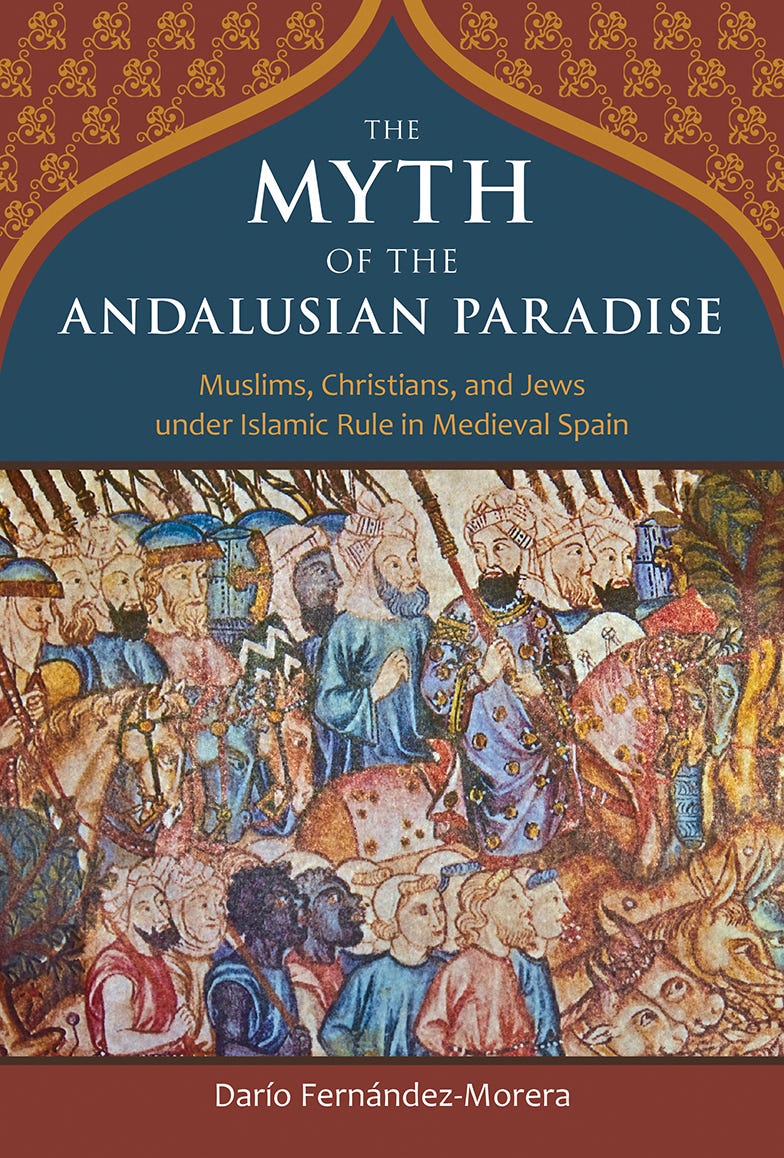
Fernández-Morera is a popular yet controversial humanities professor (now retired) and author, with a PhD from Harvard. In a chapter titled “The Daily Realities of Al-Andalus,” he draws rigorously on legal texts, contemporary accounts, and supporting historical evidence to reconstruct the real position of music under the Maliki school of Sharia (Islamic law), which dominated and governed Islamic Spain.
The picture this describes is quite stark.
Musical instruments and singing were not simply discouraged, but explicitly restricted. In some cases, authorities were empowered to enter private homes if music was heard and destroy the instruments. Legal texts warned against listening to singers or musicians.
As one Maliki text puts it:
“It is not lawful for you to deliberately listen… to musicians and singers.”
And in practice, according to historical accounts, these restrictions could be actively enforced:
“Judges ordered people’s musical instruments confiscated and destroyed.”
These weren’t marginal views. They formed part of the prevailing legal framework.
That, in itself, isn’t the point.
What struck me was the implication.
The Constraint
If those conditions were broadly true — even if unevenly applied — what does that mean for the place of music in that society?
Because music clearly existed. There are contemporary records of musicians, of performances, even of instruments being made, and even particular styles (for example, accounts mention outlawed gypsy folk music, the likely precursor of modern flamenco).
But music in Al-Andalus appears to have existed in constant tension with the prevailing legal and moral framework, rather than being openly supported by it.
More broadly, some contemporary accounts also describe a culture structured around clear hierarchies of power and control, which adds another layer of complexity to the picture.
The Flourishing
Listening to Fernández-Morera’s book reminded me that I had also come across a very different account of music in Al-Andalus.
In a widely read piece here on Substack, influential music historian Ted Gioia of The Honest Broker describes Islamic medieval Córdoba as a kind of prototype for musical innovation — a place where cultures met, mixed, and created something new.

The model is clear: diversity, proximity, and exchange produce new forms of music.
It’s a compelling idea. It seems presented less as a detailed historical reconstruction and more as a proposed model — a way of thinking about how musical cultures may form. It also seems not to be presented as an isolated short (a decade or two) innovative multicultural blip on the radar of an otherwise desolate and culturally repressed landscape, but more as something lasting, that developed over and continued for several generations at least.
And it’s easy to see why this idea resonates. Gioia's description paints an enchanting picture. Córdoba at that time is portrayed as the main catalytic crucible of musical innovation in Europe, like New Orleans was to Jazz.
That account draws, in part, on a broader narrative that became widely accepted, and now mainstream (which is why people like Fernández-Morera are labelled controversial): Convivencia, a Spanish term meaning "coexistence" or "living together”.
Works such as The Ornament of the World by María Rosa Menocal present this period as one of cultural coexistence — a complex but ultimately fertile environment in which different traditions lived side by side and influenced one another. In particular, Al-Andalus is described as a place of “remarkable cultural openness” and “creative coexistence”
As one widely cited formulation puts it:
“Jews, Christians, and Muslims lived side by side…
which nourished a complex culture of tolerance.”
In some cases, that claim is stated quite directly…
The Gap
…which is why the contrast is difficult to ignore.
On one hand, Fernández-Morera presents a picture of restriction, where music exists but within limits — sometimes informal, sometimes strictly and ruthlessly enforced.
On the other, Gioia presents a picture of flourishing, where cultural intermixing drives artistic innovation.
These two descriptions don’t easily sit together.
Was that Córdoba, that cultural crossroads and melting pot, the exception to the rule? And how certain are we of the picture we’re now relying on?
It doesn’t necessarily mean that one description is entirely right and the other entirely wrong.
It may be that both are describing different aspects of the same reality — legal frameworks on one side, lived practice on the other; elite environments and cultural hotspots versus broader social norms; periods of tolerance alongside periods of enforcement.
But it does suggest that the story is much more complicated than a single, coherent narrative.
A Thought Experiment
There’s a further implication here that’s also difficult to ignore.
If a culture places sustained limits on music — even intermittently — what does that do over time?
Because much of what we now take for granted in Western music depends on continuity, experimentation, and a certain kind of permission.
Remove that, or constrain it significantly, and the trajectory might look very different.
Dario Fernández-Morera pushes this further.
In The Myth of the Andalusian Paradise, he suggests that if the legal and cultural framework he describes had prevailed more broadly across Europe, if the attempted Islamic conquest of Central Europe had succeeded, the development of Western music as we know it might not have unfolded in the same way — or at all.
That’s a strong claim.
And it’s speculative.
But it’s also difficult to dismiss outright.
Because musical traditions don’t emerge in isolation. They depend on what a culture permits, encourages, and transmits.
If those conditions shift, the outcome shifts.
So it’s worth pausing on, even briefly.
Not as a conclusion — but as a way of testing the assumptions we bring to the story.
What if the environment had been different?
What if the constraints had been the dominant condition, rather than the exception?
What, exactly, would we expect to hear now?
Would polyphony, Gregorian chant, diatonic harmony, modal counterpoint, pop music, rock or jazz have developed…?
Of course, it is speculative.
But also not entirely unreasonable.
Cultural environments shape what gets explored, developed, and passed on.
And music is no exception.
A Question
What stayed with me wasn’t the answer to any of this.
It was the gap, like the Grand Canyon, between the two proposed historical views.
And the undeniable question that huge gap points towards…
How often do we inherit a version of events that feels plausible, comfortable and coherent — until something small, provable and uncomfortable disrupts it?
And what do we do when that happens?

When rock and roll first appeared it directly clashed with the conservative, suburban culture of 1950s America. It was even labelled as “satan’s music” by church leaders and politicians. It emerged from African American musical traditions (rhythm & blues, gospel, jump blues) and was a direct threat to the segregation that was still the norm. Maybe there are a few correlations here.
Fuck, man. Such a difficult, interesting, and thought-provoking question you ask here. With age (and I do realise I'm younger than most here) I'm increasingly becoming more receptive to the idea that two seemingly differing accounts can be both simultaneously true and simultaneously inaccurate when taken in isolation. When historians (or anyone wearing a historian's hat) tell a certain story, they will choose to highlight certain elements. Sometimes knowingly. Sometimes subconsciously. Sometimes, the source they are using may be biased or simply incomplete. This is why I think it's really important to read and highlight a variety of sources, a multitude of authorised voices, like I know you do in your life and like you're doing here. That may not give us all the answers, but it will definitely bring us closer to the truth. Thank you for such a terrific post.